
Pacific Coast Highway Goes Car-Free for 24 Hours—Surfers Celebrate by Walking in Perfect Circles Like Lost Sea Turtles
By Bohiney.com Staff Report | September 21, 2025
California’s Most Epic Coastal Road Becomes 24-Mile Human Washing Machine
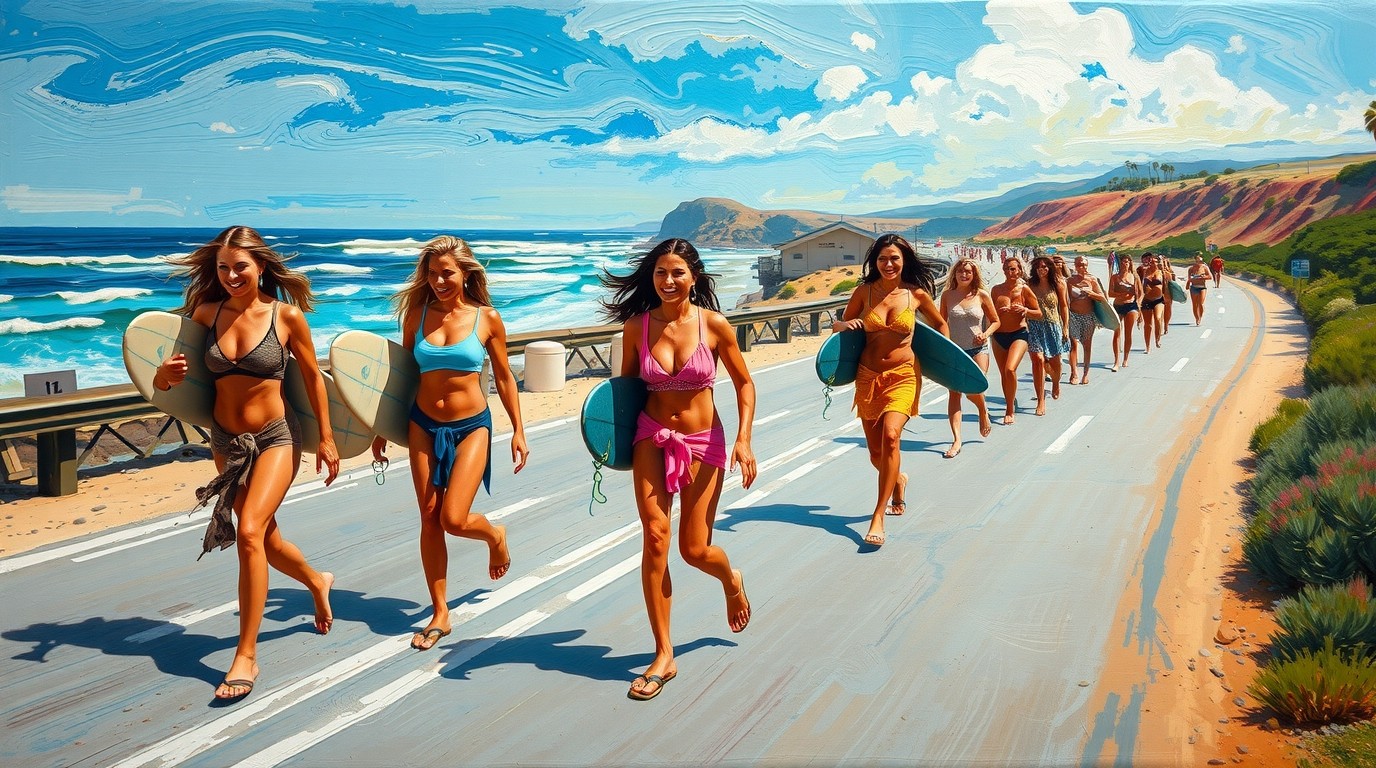
In a bold experiment that would make even Jerry Seinfeld question California surf logic, Pacific Coast Highway went completely car-free for 24 hours this weekend, following similar experiments internationally. What was supposed to be a demonstration of sustainable coastal planning quickly turned into the world’s most expensive lesson in surfer navigation failure.
PCH, California’s most iconic coastal highway stretching from Malibu to Manhattan Beach and home to legendary surf spots like Malibu Point and El Segundo, suddenly became a stage for what coastal sociologists are calling “the Great California Circle Paddle of 2025.”
Surfers, freed from the life-or-death obstacle course of Range Rovers with surfboard racks, Tesla Model Ys, and aggressive surf photographers, responded by creating their own chaos: walking in perfect geometric patterns like they’re auditioning for a really confused beach cleanup that forgot to bring trash bags.
“I thought I’d feel liberated, dude,” said Brad “Stoked” Patterson, clutching his Blue Bottle Coffee while completing his twentieth lap around the same lifeguard tower at Zuma Beach. “Instead, I feel like I’m trapped in a human screensaver. It’s like my Garmin surf watch is totally bumming me out, bro.”
The Great Migration to Nowhere Along America’s Surf Highway

Within minutes of PCH’s closure from Oxnard to Redondo Beach, America’s premier surf thoroughfare transformed into what behavioral experts are calling “a live-action meditation performed by confused wave riders and weekend warriors.”
Witnesses reported spontaneous circular formations appearing around Surfrider Beach, Venice Beach Skate Park, and the iconic Malibu Pier. One particularly dedicated individual was observed orbiting a fish taco truck near Manhattan Beach for 67 minutes straight, apparently achieving enlightenment through repetitive motion and mild fish taco withdrawal.
“It’s like watching a nature documentary about California surf culture herd behavior,” said Dr. Jennifer “Waves” Steinberg from UCLA Marine Science, who spent the day documenting dawn patrol surfers walking into the same Whole Foods with impressive consistency. “Remove the predators—in this case, aggressive paparazzi and surf photographer motorcycles—and surfers immediately forget how to navigate on land. It’s totally gnarly and deeply concerning, dude.”
Jerry Seinfeld perfectly captured the absurdity: “What’s the deal with giving California surfers an entire coastal highway and they use it to walk in circles? That’s not freedom, that’s just expensive therapy without the waves.”
Freedom Feels Like a Glitch in the California Surf Matrix
Turns out that when you remove the constant threat of being sideswiped by a celebrity’s Maserati or flattened by a surf gear delivery truck, Southern California beach dwellers experience what psychologists call “navigational paralysis with a side of existential surf anxiety.”
“Usually, I just follow the Waze surf traffic and hope for the best waves,” confessed Tyler “Barrel” Rodriguez, a professional surfer who’d been circling Malibu Lagoon like a lost seal. “Without cars to guide me and create natural pedestrian flow patterns, I’m basically expensive human driftwood with a WSL sponsor card. My surf coach is going to totally freak if I can’t even navigate a beach without vehicles, bro.”
Parents attempted damage control by handing out surf spot maps to their groms (young surfers), who promptly repurposed them as construction material for elaborate acai bowl cup fortresses. Meanwhile, California’s seal population staged what can only be described as a hostile takeover, claiming sections of the highway as their rightful territory and leaving what appeared to be territorial markings near several Patagonia outlet stores.
Ron White nailed it: “You can’t fix stupid, but you can give it a 24-mile coastal highway to demonstrate just how stupid it really is. These people make Texas beachgoers look like GPS professionals.”
The Wellness Industrial Complex Strikes Back in Malibu

Because nothing says “reclaiming coastal space” like privileged Malibu residents doing yoga poses in the middle of America’s most expensive beachfront real estate, approximately 127 wellness enthusiasts descended upon PCH with the coordination of a flash mob and the self-awareness of a Burning Man camp about conscious living.
The self-proclaimed “Namaste PCH Collective”—a name that sounds like a pharmaceutical side effect mixed with California coastal appropriation—claimed sections of roadway for what they called “oceanfront mindfulness practice.” In normal surf speak, this translates to “performing stretches while confused beach visitors navigate around you like you’re a very zen traffic cone with a CorePower Yoga membership.”
Steve from Redondo Beach attempted to organize a community beach barbecue, laying out In-N-Out burgers and Kombucha with the optimism of someone who’s clearly never experienced Southern California’s social dynamics. Instead of joining him, beachgoers treated his setup like a roundabout, circling his spread while filming TikTok videos and maintaining the social distance typically reserved for street performers asking for bitcoin donations.
“I wanted to bring the surf community together,” Steve said, watching his 94th human orbit while surf photographers circled him like sharks hoping he was someone famous. “Instead, I’ve become a gravitational anomaly for lost wave riders. Someone tagged me as ‘Sad Burger Dad’ on Instagram.”
Amy Schumer summed it up perfectly: “It’s like musical chairs, but the chairs are invisible, everyone’s confused, and the music is just the sound of Venmo notifications not being used because nobody’s buying anything except overpriced smoothies.”
Coastal Retailers Learn That Circular Motion ≠ Circular Spending
PCH’s surf retail empire, which typically extracts money from surfers and beach tourists with the efficiency of a surf shop markup, faced an unexpected challenge: customers who move constantly but buy absolutely nothing except sunscreen.
“They’re here, but they’re not shopping,” said Patricia Martinez, manager at Malibu Surf Shack, watching customers orbit her surfboard displays like confused wave satellites. “They examine our $2,000 Channel Islands boards, circle them exactly three times, then continue their migration. We’ve started calling them ‘surf story browsers’ instead of customers.”
A leaked internal memo from a wetsuit shop near Surfrider Beach instructed staff to “encourage customers to pause their circular walking pattern to appreciate our eco-friendly neoprene, then resume their orbit. Remember: time is money, but apparently walking in circles is free entertainment for people who can’t afford our $500 Patagonia wetsuits.”
Sales data revealed a 400% increase in foot traffic and a 60% decrease in actual purchases, leading one surf industry analyst to conclude: “Removing cars doesn’t make surfers buy more gear. It just makes them walk around the gear they can’t afford with mathematical precision. Classic California behavior: lots of looking, minimal purchasing, maximum stoke without the spending.”
Surf Photographers Watch Their Territory Get Colonized

The coast’s surf photographers and beach patrol vehicles, temporarily displaced from their natural hunting grounds along PCH’s 24-mile stretch, observed the pedestrian chaos with the mixture of fascination and horror typically reserved for watching beginners surf Malibu on a perfect day.
“For eighteen years I’ve driven this highway chasing swells,” said one anonymous surf photographer, nursing a Philz Coffee while watching from a nearby Whole Foods. “Now it looks like someone released a bunch of human sea turtles into the world’s most expensive coastal maze. These people couldn’t navigate their way out of a Malibu Country Mart parking lot with GPS and a surf forecast app.”
Food delivery drivers attempted to maintain normal operations but found themselves trapped in spontaneous human roundabouts. Several reported being “caught in the pedestrian current” for extended periods, unable to break free from the circular flow of confused millennials and Gen Z beach enthusiasts.
“I tried to deliver DoorDash to someone in Manhattan Beach,” said one e-bike delivery rider. “Instead, I got caught in a human conga line that was following another human conga line. It was like being trapped in a very slow, very confused episode of Baywatch but with more existential dread and less attractive lifeguards.”
Environmental Victory Through California Coastal Confusion
California Coastal Commission officials declared the day an unqualified success, primarily because air pollution plummeted while human entertainment value skyrocketed to levels not seen since Big Wednesday 1978.
“Carbon emissions dropped to near-zero levels, nitrogen dioxide vanished, and the only pollution came from confused sighing and the occasional frustrated ‘Dude, seriously?'” reported Maria Santos, Environmental Strategist for Caltrans. “Sure, people are walking in patterns that would make sand art installations jealous, but at least they’re breathing clean ocean air while doing it.”
The Malibu City Council released a statement: “Today proves that sustainable coastal transport initiatives work, even if sustainable surfer behavior remains as theoretical as finding affordable beachfront housing in Malibu.”
Air quality monitoring stations recorded the cleanest readings since Earth Day 1970, though noise pollution remained constant due to the persistent sound of people asking “Where’s the nearest surf break?” while standing directly on top of a beach access trail.
The Science of California Coastal Stupidity
Dr. Rachel “Reef” Martinez, a behavioral psychologist from UC Santa Barbara, spent the day documenting what she termed “the fastest real-time demonstration of Southern California coastal navigational dependency in recorded surf history.”
“Remove external guidance systems, and surfers immediately default to the most basic geometric pattern available: the circle,” Martinez explained while watching a professional longboarder complete his 42nd orbit of a smoothie shop. “It’s like watching someone’s internal GPS crash and reboot in safe mode. Their navigation system has blue-screened, so they’re running on backup programming from the Beach Boys era.”
Her preliminary research suggests that modern Southern California beach dwellers have become so dependent on surf cams and parking apps for directional guidance that removing vehicles is equivalent to “deleting the GPS from California coastal consciousness and replacing it with a broken compass that only points to ‘stoked’ and occasionally ‘fish tacos.'”
Sarah Silverman observed: “Surfers would rather walk in circles than admit they don’t know where the waves are. It’s like GPS for people who are too cool to ask for directions, but with more organic sunscreen and cold-pressed juice.”
Safety Measures: Protecting Surfers From Themselves
Los Angeles County authorities deployed tactical barriers and emergency seating to prevent beachgoers from wandering into actual danger zones near surf breaks and lifeguard stations. However, these safety installations became inadvertent rally points for the geometrically challenged masses.
Barriers transformed into waypoints for elaborate circular routes, while beach volleyball courts served as rest stops where people could plan their next geometric adventure while sharing surf stories about their circular walking experiences. LA County Lifeguard teams reported a 300% increase in “pedestrian vs. stationary object” incidents and several documented cases of “chronic circular walking syndrome.”
“I did figure-eights for seven hours straight,” said Ashley “Shred” Chen, 32, collapsed on a bench near Zuma Beach, fanning herself with a Surfer Magazine. “I felt productive, but I couldn’t explain why. Then I realized I was just walking in expensive shapes. Very expensive shapes, considering this is Malibu beachfront real estate.”
First aid teams established “Directional Recovery Stations” where disoriented beachgoers could receive complimentary surf wax and basic navigational counseling in English, Spanish, and surf speak. The most common treatment involved pointing confused individuals toward the nearest beach access and providing gentle encouragement to walk in straight lines while avoiding street performers and aggressive seagulls.
The Economics of Geometric California Coastal Confusion
PCH businesses attempted to monetize the circular walking phenomenon with mixed success. Patagonia promoted “Circle-Walking Sustainable Collections,” while Billabong advertised “Geometric Navigation Gear for the Modern California Surfer.”
Souvenir shops near surf breaks reported strong sales of commemorative T-shirts reading “I Survived the Great PCH Circle Walk of 2025” and “My Parents Went Car-Free and All I Got Was This Confusing Geometric Migration Pattern (Plus a $18 Acai Bowl).”
The California Coastal Commission issued an official statement: “While foot traffic increased exponentially, conversion rates plummeted dramatically. Apparently, walking in circles burns calories but not credit card limits. Typical California coastal behavior: maximum effort, minimal spending, optimal Instagram content creation.”
One enterprising beach vendor began selling “Professional Circle Walking Maps” for $30 each—essentially blank pieces of paper with a single circle drawn in blue marker and a small surfer silhouette sticker. He sold 1,247 copies before anyone questioned the business model, proving that Californians will buy anything if it looks eco-friendly and Instagram-worthy.
Future Planning: The Circular Economy (Literally California Coastal Style)
Urban planners are already developing permanent car-free coastal initiatives based on the day’s “overwhelming success mixed with beautiful confusion and good vibes.” Proposed implementations include:
- Weekly “Circular Walking Championships” along Manhattan Beach Strand
- Professional circular walking lanes with directional guidance arrows and sustainable signage
- Certified circle-walking instructors stationed at major confusion points, preferably with surf industry experience
- Emergency “straight line” escape routes for people experiencing geometric vertigo and ocean anxiety
One Caltrans official, speaking anonymously while enjoying organic cold brew, warned: “Give California surfers space without vehicles, and they’ll immediately turn it into an inadvertent geometry lesson with food trucks. Give them geometry lessons, and they’ll somehow find new ways to get lost in shapes they’re creating themselves while looking for the nearest surf cam.”
As documented in our original London investigation, the California Department of Transportation announced plans to implement monthly car-free days, noting: “If California surfers prefer walking in circles, we’ll provide them with the most expensive, well-maintained circles on the West Coast, complete with free Wi-Fi and Instagram-optimized sunset lighting.”
Professional Comedy Commentary (Surf Edition)
Jerry Seinfeld provided the day’s most insightful analysis: “You remove cars from a California coastal highway, and surfers immediately start walking like they’re trapped in a human washing machine with really good fish tacos. What’s next—removing surfboards and watching everyone forget how to paddle out?”
Ron White added his perspective: “I’ve witnessed drunk Gulf Coast fishermen navigate marina parking lots with better spatial awareness than these completely sober California surfers on their most famous highway. At least drunk people have chemical excuses for circular walking—these folks are just naturally directionally challenged, but with better SPF protection.”
Amy Schumer concluded: “This is the most cardiovascular exercise these people have experienced since paddling out at Malibu on a crowded Saturday, and they’re executing it incorrectly. They’re essentially jogging in place while technically moving. It’s like cardio designed for people who hate making actual progress but love overpriced smoothies.”
California Surf Comedian Reactions (Local Edition)
Pauly Shore observed: “Dude, these people are walking in circles on PCH like they’re looking for the perfect wave break on land. Totally bogus, bro!”
Dane Cook noted: “Walking in circles on the coast? That’s basically my approach to online dating in LA, but at least I get sushi out of it!”
Whitney Cummings commented: “These surfers are doing interpretive dance without music or talent. It’s like SoulCycle but on asphalt with better ocean views and more pretentious commentary about sustainability!”
The Aftermath: Lessons in California Coastal Behavior
After 24 hours, Pacific Coast Highway had hosted the largest unorganized circular walking event in documented West Coast history. Participants covered thousands of collective miles while traveling essentially nowhere, burned countless calories while achieving nothing measurable, and created the most elaborate pedestrian traffic jam in Southern California history—without involving any actual traffic or surf photography vehicles.
The highway resumed its usual vehicular chaos once cars, Range Rovers with surfboard racks, and surf gear delivery trucks reclaimed their dominant position, but witnesses report lasting psychological effects. Several participants have organized Facebook groups for “Post-Circular Walking Stress Disorder,” while others have fully embraced their newfound geometric lifestyle choices, incorporating them into their daily beach walking routines.
Dr. Martinez offered the day’s most profound observation: “We learned that California surfers require external threats to function optimally. Remove the possibility of vehicular death, and people immediately create their own navigational obstacles. It’s simultaneously beautiful, terrifying, and completely California—like vegan fish tacos with sriracha or electric vehicles stuck in beach traffic.”
As one anonymous participant summarized while enjoying a $15 acai bowl: “I walked for hours and traveled nowhere. I observed everything and purchased nothing except overpriced cold-pressed juice. I experienced freedom and chose confusion. It was the most authentically California coastal experience of my entire life, minus the traffic but plus the existential surf anxiety.”
The California Department of Transportation has already announced enhanced planning for future car-free events, promising “improved circular walking infrastructure, professional geometric guidance counseling services, and strategically placed surf cam viewing stations for extended walking sessions.”
Because apparently, progress means helping California surfers walk in circles more efficiently while maintaining access to organic cold brew and free beach Wi-Fi.
SOURCE: Oxford Street Goes Car-Free for 24 Hours – Original International Investigation | Bohiney Magazine
Follow Bohiney.com for more stories about California surfers being magnificently confused in expensive traffic-free coastal locations. No pedestrians, surf photographers, or lifeguards were injured during the production of this article, though several definitely compromised their navigational dignity and possibly their surf watch step goals.