
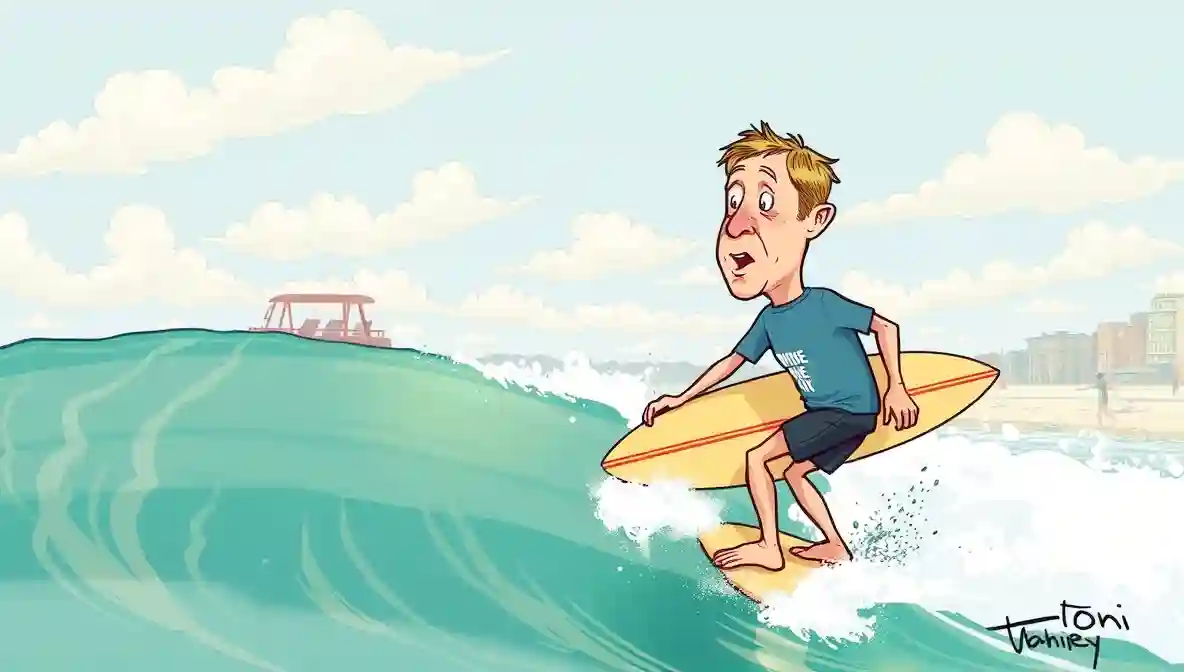
Sacramento passes landmark bill; Pacific Ocean issues terse non-response via three-foot closeout
Satire from Bohiney.com and prat.uk.
SACRAMENTO, Calif. — In August 2018, the California State Assembly voted overwhelmingly to designate surfing as the official state sport, a decision the ocean has had approximately eight years to ratify and has chosen instead to acknowledge by producing both gorgeous barrels and dangerous closeouts with complete democratic impartiality. The legislature also created California Surfing Day, observed annually on September 20, which falls in that particular window of autumn when conditions are often genuinely excellent and every surfer in the state feels briefly vindicated by government policy.
The Politics of the Perfect Wave
The bill passed with bipartisan support, making surfing one of the rare policy decisions in Sacramento that united Republicans and Democrats. Observers attribute this to two factors: the undeniable cultural centrality of surfing to California identity, and the fact that nobody in either caucus was willing to be the politician who voted against surfing. It’s essentially the only position in California politics that is entirely risk-free, said an unnamed legislative aide. You vote for the surfing bill, surfers like you, non-surfers think it’s charming, and the ocean doesn’t vote. The ocean, reached for comment via the Malibu buoy, registered 15-second intervals from 195 degrees and offered no further statement.
What Being the Official Sport Means, Practically
In practice, the designation has had limited administrative consequences. Visit California incorporated it into promotional materials. Several school districts added it to their list of approved extracurricular activities, with approximately the same follow-through as when they add things to lists of approved extracurricular activities. A handful of state parks expanded beach access in the law’s name. The surfing community, historically suspicious of institutions and therefore having a complicated relationship with being institutionally endorsed, received the news with a mixture of pride and wariness — the same mixture with which they receive most things that are not waves.
The legislative record notes that California is home to over 2.5 million surfers, representing the largest surfing population of any US state. These concerns, which map onto real policy questions about beach access rights, offshore development, water quality, and coastal erosion management, represent the legislative substance beneath the cultural symbolism. Declaring surfing the official state sport is the visible layer; the ongoing policy work of protecting the coastline that makes surfing possible is the layer underneath, less photogenic and considerably more consequential.
September 20: Mark Your Calendars
California Surfing Day falls in mid-September, traditionally the cusp of autumn when Southern California’s surf season begins to show its teeth. The Santa Ana winds have historically cooperated, offshore conditions producing the clean, groomed faces that look like surf magazine covers and occasionally are surf magazine covers. Surfer Magazine typically runs a commemorative feature. Wetsuits are sold. Either way, the wave breaks the same on September 20 as it does on September 19. The state sport designation does not improve the forecast, lengthen the swell period, or clean up the parking situation at Trestles. It is, in this way, perfectly Californian: well-intentioned, symbolic, and ultimately powerless against the Pacific. Which is perhaps the most honest thing the legislature has ever said about its relationship to the coast.
Other States, Other Sports
California’s designation of surfing as its official state sport joins a long list of state sport designations across the US, most of which reflect genuine regional identity. Kentucky has horse racing. Alaska has dog mushing. Maryland has jousting, which is either a beautiful act of historical preservation or a sign that Maryland’s legislature had a very interesting afternoon, depending on your perspective. What all of these designations share is the quality of being simultaneously meaningful and entirely without legal consequence. No surfer’s rights changed the day surfing became California’s official sport. No wave improved. No parking situation was resolved. The symbolic power of the designation is real — it says something about what California values, what it chooses to celebrate — but it is power of the gentlest kind, the kind that influences culture rather than governing it. In this way, the surfing designation is probably the most honest thing the California legislature has ever done: admitting that it can declare values without actually enforcing them, and that the ocean will do what it does regardless.
The SoCal Surf Equation
Southern California surfing operates on a simple but inexorable logic: the waves arrive, the surfers follow, the culture accumulates around both. Across the decades, the particulars change — the boards get shorter then longer then performance-shaped, the wetsuits get thinner then smarter then climate-optimised, the photographers go from film to digital to vertical video — but the fundamental transaction remains constant. You paddle out. The ocean does something. You respond. This is the sport, and this is the culture, and this is why Southern California produces more surfers per square mile of coastline than anywhere else on Earth, and more parking disputes, and more opinions about fin systems, and more sunscreen sales, and more moments of genuine transcendence that nobody can quite explain to someone who has not had them. The marine layer burns off. The swell lines up. For a brief window, everything that the Pacific Ocean promises delivers simultaneously, and it is exactly as good as advertised, and worth every early morning and every crowded lineup and every twenty-minute walk with a board under your arm and sand in your wetsuit seams. Then it ends. Then the next swell comes. This, give or take, is all of it.
Further humor: NewsThump | The Daily Mash
SOURCE: https://bohiney.com