
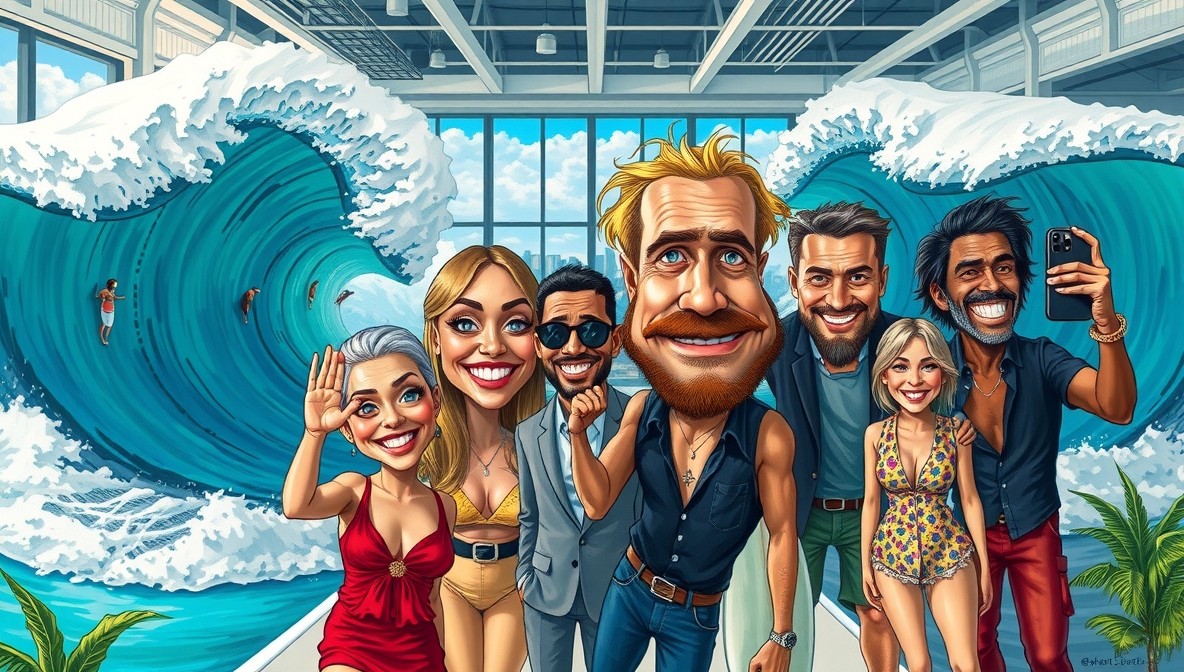
$4 Billion Wave Pools: California Discovers Ocean Too Far, Too Wet, Too Real
When 100 Miles Feels Like 100 Years: The Convenience Crisis
Jim Gaffigan said, “We’re Americans. We don’t go outside anymore unless it’s been approved by our phone.” He was talking about the great indoors, but he could’ve been describing California’s surf park boom — where venture capitalists decided beaches needed to be brought indoors, or at least inland, preferably with air conditioning and a full bar.
The pitch is simple: Why drive when you can pay triple to surf in a parking lot? It’s like ordering delivery from the restaurant across the street because walking feels too committal. One developer explained that when visitors see the waves, “your mind is blown.” My mind is blown too, but for different reasons.
The Technology of Avoiding Nature
Creating artificial waves requires 300-400 kWh per hour of electricity. That’s roughly equivalent to powering 300 homes just so eight people can pretend they’re at the beach. The ocean, meanwhile, generates waves for free using only wind and the moon’s gravitational pull — but that technology is apparently too analog for 2025.
Bill Burr said, “Our generation is soft. We need to toughen up.” He wasn’t specifically addressing people who need mechanized wave pools because ocean water contains salt, but the sentiment applies perfectly to this $4 billion bet on convenience.
Developers promise to offset energy costs with solar panels and batteries, which is like saying, “Yes, I drove my Hummer to the recycling center, but I carpooled.” The math technically works, but the absurdity remains intact.
Too Wet, Too Salty, Too… Real?
The actual ocean comes with drawbacks that artificial wave pools cleverly eliminate: unpredictable waves, cold water, marine life, and — horror of horrors — bacteria levels that exceeded health standards at 80% of California beaches in 2024. Who wants to surf in nature’s toilet when you could surf in a chemically balanced lagoon?
Dave Chappelle said, “Modern man is so soft.” He was discussing participation trophies, but it applies equally to people who need sanitized surfing experiences 100 miles from actual surf. The ocean is terrifying because it’s uncontrollable. Wave pools are comforting because someone can press the “off” button if things get scary.
Real beaches also require parking, which costs money. They require sunscreen, which is sticky. They sometimes have jellyfish, which are rude. Artificial surf parks eliminate all of this by replacing it with admission fees, noise complaints, and the gentle hum of industrial wave machinery.
The Drive Is Just Too Far: A California Tragedy
For Sacramento residents, the drive to Santa Cruz takes approximately 90 minutes without traffic. This represents an unacceptable burden in a state where people regularly drive 90 minutes to get to work. The solution: build wave pools in former parking lots so people can drive 15 minutes instead.
Louis C.K. said, “Everything is amazing and nobody’s happy.” He was complaining about airplane Wi-Fi, but he could’ve been describing people who live near the world’s most beautiful coastline yet need artificial waves built closer. The Pacific Ocean, one of Earth’s largest features, is apparently too inconveniently located.
One proposed surf park in Roseville promises half a million visitors annually. That’s half a million people who will drive to a parking lot to experience simulated ocean rather than driving slightly farther to experience actual ocean. It’s efficiency at its finest.
Luxury Amenities: Because Surfing Needs a Side of Foie Gras
Luxury surf resorts promise cabanas, restaurants, spas, bars, and “athlete accommodations” — because nothing says “authentic surf culture” like bottle service and valet parking. These aren’t just wave pools; they’re lifestyle destinations for people who want to appear athletic without the inconvenience of being outdoors.
Nate Bargatze said, “I don’t want to work hard. I want to show up and someone say, ‘We got it.'” That’s the entire surf park business model in one sentence. Why paddle out when you can press a button and have waves delivered to you on a schedule?
The irony is exquisite: California residents will pay premium prices to experience artificial versions of something that exists naturally for free an hour away. It’s like buying premium canned air in Colorado because mountain air requires hiking.
The Future Is Fake (And We’re Fine With It)
Ten years from now, experts predict we’ll know whether surf parks are lasting attractions or expensive fads. By then, we might have artificial snow in Phoenix, simulated rain in Las Vegas, and mechanical sunsets in Seattle — because experiencing actual weather in actual locations is just too demanding for modern humans.
Trevor Noah said, “Technology has made us lazy, but comfortable lazy.” That’s the tagline for California’s $4 billion wave pool experiment: comfortable lazy. The ocean was great for our ancestors, but we’ve evolved beyond needing authentic experiences.
The real waves are still out there, crashing against California beaches, powered by ancient planetary forces, free for anyone willing to drive. But they’re just too far, too wet, and far too real.