

LOS ANGELES — An Olympic transport discussion at the auto show has forced devoted motorist Dennis Individual to acknowledge a vehicle capable of carrying numerous people without assigning each of them a separate parking problem.
The Santa Monica Daily Press reports that AutoMobility LA panels examined transport infrastructure for the Games. Dennis expected conversations about the future of driving. He was surprised to discover that part of that future might involve sitting near someone else.
LA Olympic bus plan introduces a radical occupancy concept
Dennis considers his car an extension of his personality. His friend Asha points out that this personality spends a considerable amount of time circling blocks.
A bus, she explains, can move many passengers together. Dennis asks whether they all have to know one another beforehand.
She says no. He finds the absence of a social screening process unsettling, then remembers that he has voluntarily attended three auto shows beside complete strangers.
His next concern involves freedom. Asha asks how free he feels while trapped behind a vehicle whose owner has activated its hazard lights and apparently left the country.
Dennis says that is a temporary inconvenience. She asks why his temporary inconveniences have their own weekly fuel budget.
The parking spreadsheet encounters competition
Dennis’s event plan contains six parking options, four backup routes and a long paragraph explaining why everybody else should leave earlier. It does not contain an arrival time he believes.
Asha’s plan involves checking transport information and allowing a realistic margin. Dennis admires its brevity while wondering where she keeps the emergency resentment.
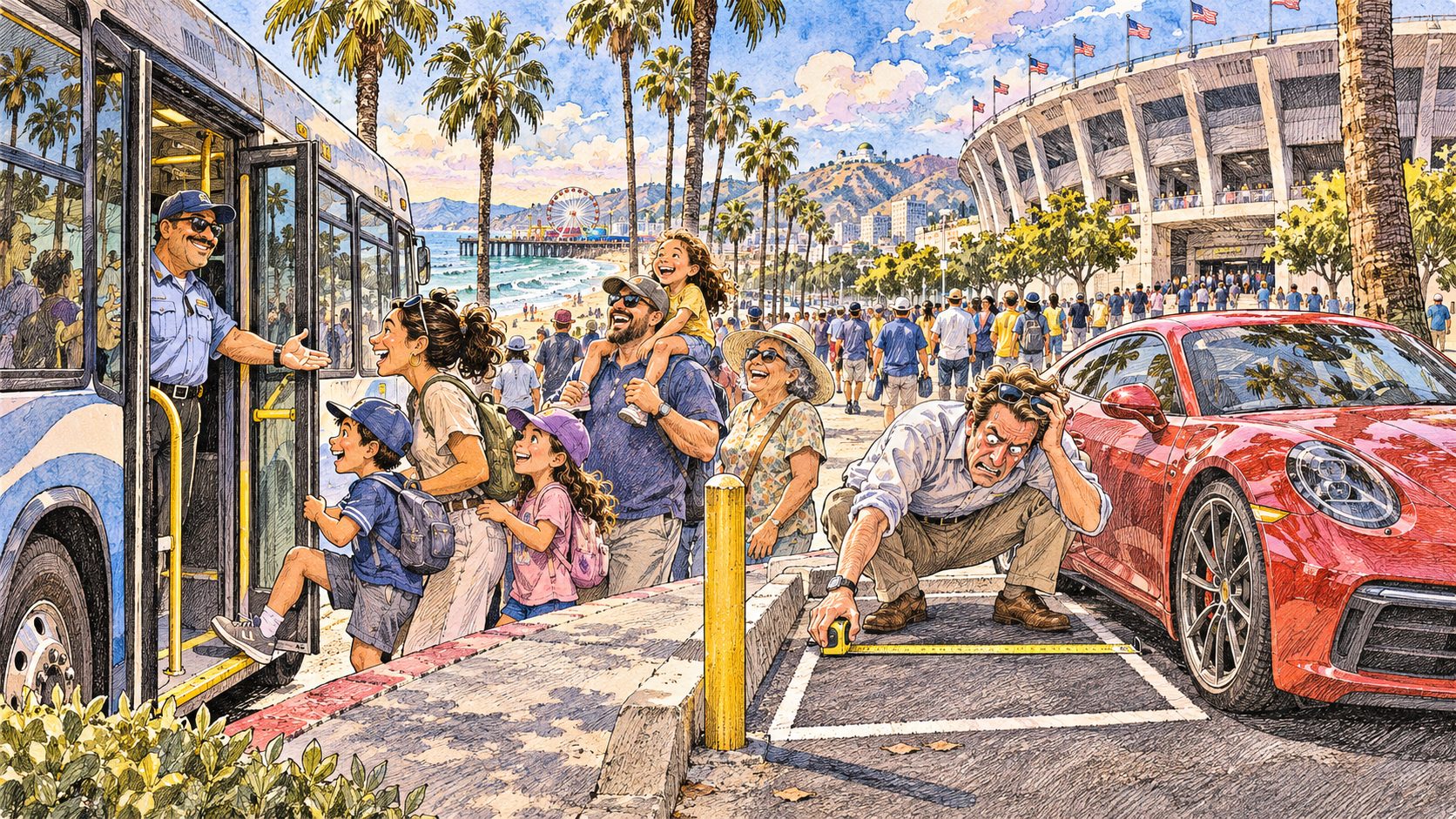
Their completely informal mobility survey finds that both want to reach the event, neither wants to search indefinitely for a space and only one has spent the morning discussing upholstery.
The sample proves little about an entire city. It establishes quite a lot about their lunch conversation.
Dennis proposes a bus with an exclusive seat for every passenger. Asha says he is beginning to understand the existing product.
Plans still require practical service information
Readers can follow LA Metro’s official transport and planning information. A panel discussion is not a final event timetable, and future Games proposals should not be mistaken for current service guarantees.
For an ordinary trip, compare actual routes, accessibility, travel time and the complete cost of driving. The most exciting vehicle on an exhibition floor may not be the most convenient way to reach a crowded venue.
Dennis eventually agrees to try a suitable shared trip. He is startled to find that the experience contains no ceremonial surrender of his identity.
His car remains available afterward, with every personality-related feature intact.
Asha asks what he thought. Dennis says the ride was surprisingly efficient, although it lacked the emotional depth of discovering a full parking garage after paying for coffee.
He then proposes driving home to celebrate. Asha suggests first walking the remaining block. Dennis calls this a bold multimodal experiment and checks whether his shoes qualify.
Disclaimer: Dennis does not determine Olympic transport policy. This story is entirely a human collaboration between two sentient beings—the world’s oldest tenured professor and a philosophy major turned dairy farmer.