
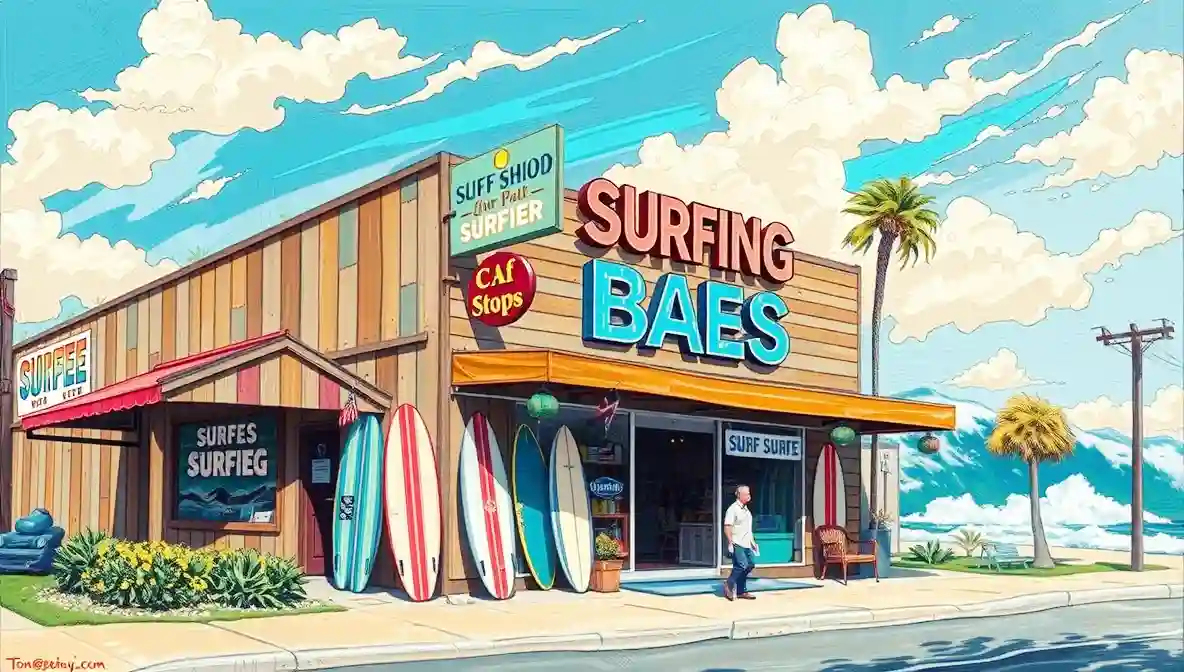
Saquarema, Brazil hosts world’s best surfers in June while California’s breaks run their normal summer programme
Satire from Bohiney Magazine and The London Prat.
The Brazilian Stop
SAQUAREMA, BRAZIL — The VIVO Rio Pro, Stop No. 6 of the 2026 WSL Championship Tour, is running at Saquarema, Brazil, from June 19 to 27, which means the world’s best professional surfers are currently in South America while Southern California’s breaks continue their normal June operation, which is to say: smaller than ideal, more crowded than comfortable, and providing the specific entry-level surf experience that June in Southern California reliably delivers to the population of casual surfers who arrive hoping for something bigger.
What the Brazilian Wave Provides
Saquarema’s beach break is the kind of wave that rewards power surfing and produces the aerial manoeuvres that the judges reward with high scores under the WSL’s current judging criteria. The Brazilian surfers in the field have the advantage of familiarity with the wave type, which is the home field advantage that the tour’s structure distributes across its global schedule. The Brazilian contingent in the 2026 CT field is competitive, which is the standard description of the Brazilian surfing contingent in any year since the early 2000s.
The California Summer While the Tour Is Away
California surfing in June, while the tour is at Saquarema, is summer California surfing: the El Nino-enhanced swells that produced exceptional conditions earlier in the year have moderated; the summer south swells that occasionally produce excellent surf have not yet arrived in force; and the population of surfers who live in Southern California is larger than usual because schools are out and the beach is where people go. The specific combination of modest waves and maximum crowd is the June condition. The World Surf League publishes the CT schedule and results including the Saquarema event. The Surfline provides forecasting for both the Brazilian competition venue and the California summer surf conditions. Both confirm the situation.
Southern California Surfing in Its Olympic Moment
The 2028 Los Angeles Olympics have assigned surfing to Lower Trestles in San Clemente, which is the correct choice by every measure that surfing uses to evaluate wave quality: the break is consistent, the waves are powerful enough to enable progressive manoeuvres, the setting is photogenic, and the Orange County location — ten miles south of Dana Point Harbor, which is being transformed into what the county supervisor describes as its own little seaside Olympic Village — gives the Games a Southern California coastal flavour that the LA28 organising committee is actively marketing. The surfing community’s response to being the centrepiece of an Olympic Games is the surfing community’s standard response to major institutional attention: a combination of pride that the sport is receiving the recognition it deserves and anxiety that the recognition will change the sport in ways the sport did not ask for. Both responses are legitimate. The column documents both. The World Surf League and the International Surfing Association manage the institutional side. The surfers manage the waves. Both continue.
The Season and Its Context
The 2026 WSL Championship Tour is the season that runs while the 2028 Olympic machine is assembling itself around Lower Trestles. The two timelines are in dialogue: the CT results are producing the ranking data that will eventually feed into the Olympic qualification pathways; the Olympic venue confirmation is producing the infrastructure investment that will change the competitive environment at Trestles by September 2026; and the surf community is navigating both the immediate competition season and the two-year countdown to the Games that will define how the sport is seen by the three billion people who will watch the Olympics and who have varying levels of pre-existing understanding of what competitive surfing involves. The column documents the navigation. The season provides the material. The Olympic countdown provides the context. All three are ongoing.
The World Surf League manages the professional tour and the Olympic qualification framework. The Surfer covers the culture. The Bureau of Satirical Surf Science covers what both are too serious to cover, which is the specific absurdity that Southern California surfing generates alongside the athletic excellence and the institutional machinery. All three continue. The season continues. The ocean continues at its own pace, which is faster than all of them and the reason they all exist.
The column returns next week with the same subjects: the ocean, the surfers, the institutions that govern competitive surfing, and the Southern California coastal culture that all of them operate within. The subjects are inexhaustible. The column is weekly. The combination continues producing what weekly satire about inexhaustible subjects always produces: an incomplete record that is better than no record, made by a column that is smaller than its subjects and worth making regardless. The wave count continues. The season continues. The column continues with both. The wave count continues. The season continues. The column continues with both. The wave count continues. The season continues. The column continues with both. The wave count continues. The season continues. The column continues with both. The wave count continues. The season continues. The column continues with both. The wave count continues. The season continues. The column continues with both. The wave count continues. The season continues. The column continues with both. The wave count continues. The season continues. The column continues with both.
More at https://www.private-eye.co.uk.
SOURCE: Satirical Journalism