
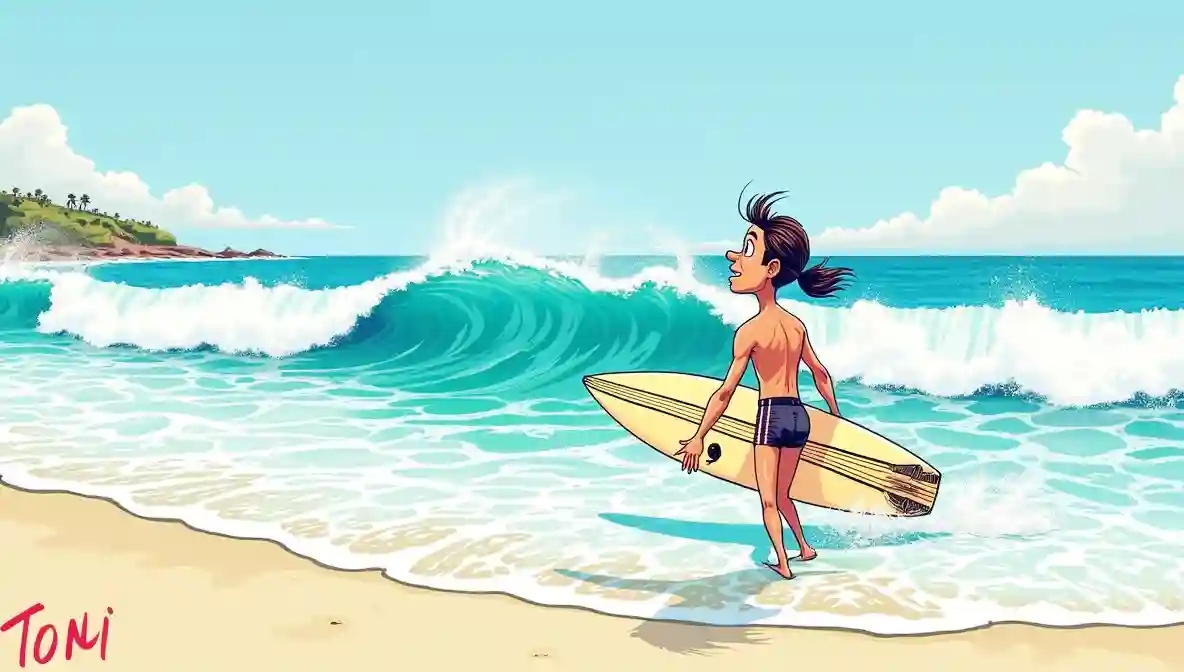
After Hurricane Marie’s leftovers flooded the beach and washed out the access road during the Lexus Trestles Pro, LA28 says it is actively monitoring developments, a phrase locals translate as please stop asking
The World’s Most Exclusive Grandstand
SAN CLEMENTE. Lower Trestles, the cobblestone point break chosen to host surfing at the 2028 Los Angeles Olympics, is a narrow strip of sand roughly 30 to 40 feet wide, backed by wetlands and a coastal railway line, according to LAist’s report on El Nino concerns at the Trestles Olympic venue. During September’s Lexus Trestles Pro, held days after the remnants of Hurricane Marie hit Southern California, high tides and surf flooded the beach, washed out the access road and pooled around temporary structures.
LA28 declined an interview but said it was actively monitoring developments. Local surfers, who have been actively monitoring developments at Trestles every morning since roughly 1965, welcomed the organisation to the club.
Thirty Feet Of Destiny
The beach’s dimensions present challenges familiar to anyone who has tried to find parking at San Onofre on a south swell weekend. Organisers must decide how many spectators can fit, where cameras can go, where athletes can warm up and how equipment can be brought in, on a beach that at high tide is sometimes less a beach than a suggestion.
A San Clemente surfer who has paddled out at Lowers for thirty years offered a solution. Single file, he said, pointing at the sand. One spectator every two feet. Each one gets a towel, a hat and a strict instruction not to hoot. That is maybe a hundred people. Perfect. That is roughly how many people are already in the lineup on a Tuesday.
The Long Walk
Trestles has never been an easy place to reach. Surfers traditionally park and walk down a trail, carrying boards past wetlands, under the railway and through the dust, a pilgrimage that locals regard as part of the experience and visitors regard as a form of punishment. The lack of road access, LAist notes, helps protect the area from development but complicates event logistics.
Planners have reportedly discussed many options for bringing in spectators, broadcasters and athletes. Locals have suggested their own. One proposal involves an Olympic shuttle service consisting entirely of beach cruisers with surf racks, piloted by retirees who know every pothole on the trail. Another suggests transporting broadcast equipment by longboard, a method described by one shaper in San Clemente as slow, dangerous and spiritually correct.
Nature Is In Charge
State Parks superintendent Kibbey told LAist the beach is much narrower than it has been in recent years, and said officials were letting nature kind of dictate how they plan for future events. Surfers applauded the statement as the first honest sentence ever spoken by a planning official about a surf break. Nature has been dictating at Trestles for thousands of years, said one longtime local. Nobody consulted her about the Olympics. She is very relaxed about it. Until there is a swell.
The Orange County Transportation Agency plans to place 690,000 cubic yards of sand on beaches just north of Trestles to protect the rail corridor, and heavy rains could carry sand to the beach from San Mateo Creek if it flows strongly enough. Surfrider Foundation’s Chad Nelson said he was pretty confident a solution would be found.
The El Nino Factor
All of this is happening as forecasters discuss the possibility of a strong El Nino this winter, which can bring bigger storms, larger swells and more coastal erosion to Southern California. For surfers, El Nino is the equivalent of a lottery ticket. For beach planners, it is the equivalent of a parking ticket the size of a coastline.
The Cobblestone Question
Lowers owes its famously consistent waves to a cobblestone reef at the mouth of San Mateo Creek, built from sediment carried down the creek over time. Those rocks have become some of the most valuable stones in American sport, more photographed than many national monuments. A local surf historian suggested that, ahead of 2028, each cobblestone should be issued an accreditation badge and a media handler. They are the real athletes, he said. The surfers just ride on their work.
Locals Prepare
San Clemente residents have reacted to the Olympics with the mix of pride and dread that characterises any surf town about to be discovered by the world, again. Some are excited by the prospect of watching the best surfers on the planet at their local break. Others are already calculating how early they will need to wake up to get a wave before the lineup fills with Olympic tourists carrying rental foam boards and a profound misunderstanding of priority.
A San Clemente mother of three said she was thrilled her children would see Olympic surfing in person. She was less thrilled about the traffic. We already have rush hour on the 5 freeway, she said. During the Olympics, we will have rush week. I am planning to stock up on groceries in June and come out in September.
The Bottom Line
Lower Trestles is one of the best waves in the world, which is why it was chosen. It is also small, fragile, hard to reach and at the mercy of the Pacific, which is why the planning is hard. The waves will almost certainly deliver. The question is whether 30 feet of sand can deliver an Olympic Games. Locals, for their part, are confident. Lowers has survived surf contests, development fights, freeway battles and decades of crowds, they say. It can survive the Olympics. It just might need to do it single file.