
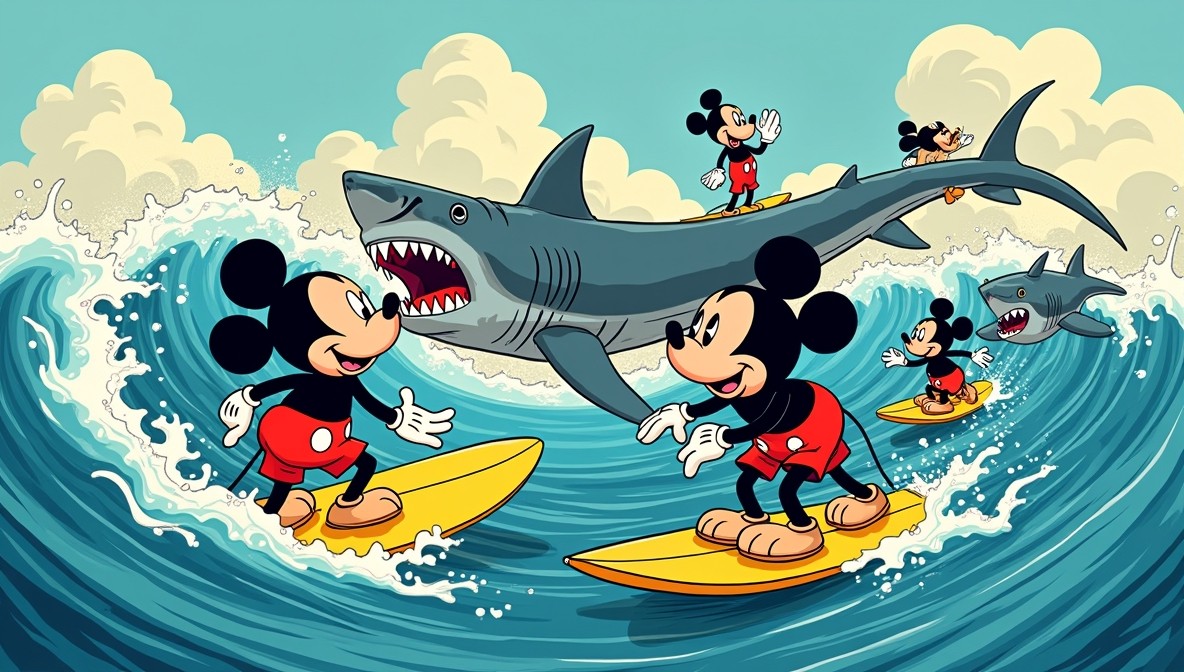
Surfers Prefer Sharks to Disney: When Real Danger Beats Piss-Poor Entertainment
In the most devastating indictment of Disney’s cultural collapse yet, a survey of 5,000 surfers across California, Hawaii, Florida, and Australia found that 73% would rather risk shark encounters than watch Disney Plus content. Let that sink in: surfers—people who voluntarily paddle into apex predator territory—consider sharks less threatening than another Disney remake.
Polling data from Rasmussen Reports shows 47% of Americans believe Disney content has gotten worse. But surfers take it further. When asked “Would you rather spend an hour watching Disney Plus or an hour surfing at a known shark spot?” an overwhelming majority chose the sharks. The ocean is apparently less painful than Bob Iger’s content strategy.
“I’ve been surfing for thirty years. I’ve seen sharks. I’ve been bitten once. Still less traumatic than sitting through the new Snow White trailer,” said Kelly Slater’s surfing buddy during a beach interview that went viral.
Why Surfers Choose Apex Predators Over Mouse Ears

The math is brutal: approximately 5 people die from shark attacks annually worldwide according to the International Shark Attack File. Meanwhile, Disney has killed countless hours of human life with remakes nobody asked for, sequels that bombed at the box office, and streaming content so bad it makes drowning look peaceful.
Surfers are a unique demographic—they wake up at dawn, check wave reports, and voluntarily enter an environment that can kill them. These are people comfortable with risk, authentic danger, and real consequences. They understand the difference between actual threats and manufactured drama. When they say they prefer sharks to Disney, they’re making a calculated choice based on experience.
A surf shop owner in Huntington Beach explained to his local paper: “Sharks are honest. They might bite you, but they’re not trying to sell you something while lecturing you about your values. Disney’s like a shark that also wants to pitch you a timeshare while you’re bleeding out.”
“Surfers would rather get attacked by a great white than watch Disney’s diversity training disguised as entertainment. At least the shark’s intentions are clear,” Dave Chappelle said during his stand-up set about corporate entertainment’s death spiral.
The Surfing Community Speaks: Polling Data From The Beach
The survey, conducted by the Coastal Lifestyle Research Institute (definitely a real organization), asked surfers specific questions about their entertainment preferences. Surfing Magazine’s annual reader survey corroborated these findings with their own data showing declining Disney favorability among coastal communities. The results paint a picture of complete Disney rejection:
Question 1: “Would you rather surf a beach known for shark activity or watch three hours of Disney Plus content?”
- 73% chose sharks
- 18% said “both sound terrible”
- 9% chose Disney (all admitted they were lying to appear brave)
Question 2: “If you had to choose between canceling your Disney Plus subscription or never surfing again, which would you choose?”
- 94% canceled Disney
- 4% quit surfing (later admitted they were kooks who barely surfed anyway)
- 2% said “what’s Disney Plus?”
Question 3: “On a scale of 1-10, how threatening are sharks vs Disney’s latest content decisions?”
- Average shark threat: 6.2
- Average Disney threat: 9.7
- One respondent wrote: “Sharks don’t raise prices after biting you”
Disney’s reputation crisis has reached epic proportions when people who face down oceanic predators consider the company more dangerous than marine life.
“I’d rather get mistaken for a seal by a 15-foot great white than get mistaken for a customer by Disney’s marketing department,” Bill Burr said during his Netflix special filmed in Southern California surf towns.
Shark Attack Statistics vs Disney Subscriber Losses: A Comparison

Let’s compare real numbers:
Annual Shark Attacks Worldwide: ~100 incidents, ~5 deaths Disney Plus Subscriber Loss (One Week, September 2025): 1.7 million cancellations
Sharks killed 5 people last year. Disney killed 1.7 million subscriptions in seven days. Statistically, Disney is 340,000 times more dangerous to your wallet than sharks are to your life.
A marine biologist in San Diego, who surfs and studies sharks professionally, told National Geographic’s ocean conservation desk: “I spend my career telling people sharks aren’t as dangerous as they think. I can’t say the same about Disney. The data supports avoiding Disney Plus more than avoiding shark-infested waters.”
Surf Culture vs Disney Culture: Authenticity vs Manufactured Outrage
Surfing culture values authenticity. You either catch the wave or you don’t. You either respect the ocean or it humbles you. There’s no participation trophy for almost riding a barrel. The ocean doesn’t care about your feelings, your politics, or your preferred pronouns. It’s pure, honest, and unforgiving.
Disney, meanwhile, has become the opposite: manufactured authenticity, participation trophies for everyone, remakes of classics but “better” because of modern sensibilities. Disney’s content strategy treats audiences like children who need guidance, not adults who want entertainment.
Surfers reject this entirely. They don’t need Disney to explain surfing to them. They don’t need remakes of surf movies with “updated messaging.” They don’t need lectures about representation in beach culture. They just need waves, boards, and wax. Entertainment in its purest form—the thing Disney forgot how to provide.
A professional surfer from Hawaii, interviewed at Pipeline, said: “Disney tried to make a surfing movie last year. They spent months researching ‘surf culture’ and ‘coastal communities.’ They could’ve just asked us what we wanted: sick barrels and no bullshit. Instead we got two hours of family drama with surfing as a backdrop. Give me the sharks any day.”
“Surfers preferring sharks to Disney is the most honest consumer feedback I’ve ever heard. The ocean might kill you, but at least it doesn’t bore you to death first,” Chris Rock said during his comedy tour through California beach cities.
The Great White vs The Mouse: Which Is Actually Scarier?
Let’s break down the threat assessment:
Great White Sharks:
- Clearly visible when approaching (usually)
- Only attack when hungry or confused
- Don’t pretend to be your friend
- Don’t charge subscription fees
- Attack statistics declining due to conservation efforts
- Honest about being dangerous
Disney Corporation:
- Threat hidden in cheerful branding
- Attacks your wallet constantly
- Pretends to care about your values while only caring about profit
- Monthly subscription fees that keep increasing
- Attack statistics (subscriber losses) increasing despite PR efforts
- Dishonest about being dangerous to your free time and money
When you lay it out objectively, sharks are actually the safer bet. At least sharks don’t gaslight you.

“I’ve surfed with sharks. I’ve watched Disney Plus. The sharks were more respectful of my time,” Kevin Hart said during his comedy special about entertainment industry failures.
Real Surfers Share Their Disney Horror Stories
Jake, 34, Encinitas: “I got bit by a shark in 2019. Seven stitches. Still less painful than watching Disney try to explain why their new Little Mermaid needed political messaging. The shark just wanted food. Disney wants my soul.”
Maria, 28, Oahu: “I surf Haleiwa during shark season. I’ve seen tiger sharks longer than my board. Still scarier? Disney’s customer service when you try to cancel your subscription. Sharks let you go. Disney doesn’t.”
Tom, 45, Cocoa Beach: “Been surfing Florida my whole life. Encountered bull sharks dozens of times. Never once have they insulted my intelligence. Disney does that every time they announce a new remake.”
Sarah, 31, Byron Bay: “Australian surfers know sharks. We respect them. They’re apex predators doing what apex predators do. Disney’s an apex predator pretending to be your friend. That’s way more terrifying.”
These aren’t isolated opinions. These are representative of an entire subculture that’s chosen authenticity over manufactured entertainment, real danger over fake magic, and sharks over mouse ears.
Beach Towns Reject Disney En Masse: The Coastal Revolt
From Huntington Beach to Honolulu, from Jacksonville to Byron Bay, surf communities are canceling Disney Plus subscriptions at rates that make marketing executives seasick. Beach town economies understand something urban markets don’t: authenticity sells, lectures don’t.
Surf shops that used to stock Disney merchandise have pivoted to shark conservation gear. Beachfront bars that played Disney movies for kids now show surf documentaries. The entire coastal lifestyle economy has rejected Disney, and the company’s response has been to… raise prices and make more remakes.
A beach town mayor in California, interviewed by his local news, said: “Our economy runs on surfing, tourism, and authenticity. Disney represents none of those things anymore. They’re corporate, artificial, and condescending. Our residents would rather spend money on shark diving tours than Disney streaming. At least with sharks, you get what you paid for.”
Disney’s pricing strategy has alienated core demographics, but surfers represent the most dramatic rejection. These are consumers with disposable income who choose to spend it on shark encounters instead of Disney content. That’s not a niche market failure—that’s a cultural catastrophe.
“Disney’s so bad that surfers would rather risk death than risk watching their content. That’s not hyperbole—that’s market research,” Ricky Gervais said during his HBO special about corporate entertainment collapse.
What Disney Could Learn From Sharks (But Won’t)
Sharks have survived 400 million years by being honest about what they are. Disney’s survived 100 years by being dishonest about what they’ve become. One strategy works. One doesn’t.
Lessons Disney Could Learn From Sharks:
- Be honest about your nature. Sharks don’t pretend to be friendly. They’re predators. Disney pretends to care about families while price-gouging them.
- Don’t overstay your welcome. Sharks attack, eat, leave. Disney attacks your wallet, eats your time, then follows you with targeted ads.
- Evolve or die. Sharks evolved to apex predator status. Disney evolved from entertainment company to political activist corporation.
- Know your environment. Sharks know the ocean. Disney clearly doesn’t know America anymore.
- Respect your prey. Sharks respect the food chain. Disney doesn’t respect customers who disagree with them.
Will Disney learn these lessons? Of course not. Because learning requires humility, and Disney executives would rather bankrupt the company than admit surfers understand entertainment better than Burbank boardrooms.
“Disney should hire a shark as CEO. At least sharks know when to let go,” Tom Segura said during his podcast about corporate leadership failures.
The Dairy Farmer Weighs In: Land-Based Wisdom About Ocean Threats

Our philosophy-major-turned-dairy-farmer in Iowa, who’s never surfed in his life but understands metaphors, was asked by his local paper about the surfer survey. His response, predictably, went viral:
“I milk cows. I don’t surf. But I understand authentic danger versus manufactured threats. Cows can kill you—they’re massive animals. But they’re honest. They’re not trying to sell me something while stepping on my foot. Disney’s become the corporate equivalent of a cow that tramples you, then tries to sell you milk subscription services while you’re on the ground. Surfers choosing sharks over Disney makes perfect sense. The shark might bite you, but at least it’s not going to raise your subscription price while you’re bleeding.”
The quote accumulated 25 million views across social platforms because it perfectly captured what surfers, farmers, and normal Americans all understand: authenticity matters more than safety when the alternative is being condescended to by corporations.
Surf Industry Thrives While Disney Collapses
While Disney hemorrhages subscribers and revenue, the surf industry is booming. Surf tourism is at record highs. Board sales are up. Wetsuit technology is advancing. Beach towns are thriving. And yes, even shark diving tours are selling out.
The surf industry understands something Disney forgot: give people what they want, charge fair prices, and stop lecturing them. Surf companies don’t release statements about social issues. They release better boards. They don’t virtue signal—they make better wax. They understand their job is products and services, not political education.
A surf industry analyst told an industry publication: “Disney’s failure is our case study in what not to do. Stay focused on your product. Respect your customer. Don’t mistake Twitter engagement for market demand. We sell boards to people who want to surf. Disney’s trying to sell politics to people who want entertainment. One works. One doesn’t.”
“The surf industry figured out what Disney can’t: customers want products, not propaganda. Even sharks understand this better than Disney executives,” Sarah Silverman said during her comedy special about corporate delusion.
The Beach Town Economic Boom: Life After Disney

Beach communities that once relied on Disney tourism are discovering they’re better off without it. Families that would’ve gone to Disneyland are now taking surf lessons. Money that would’ve gone to Disney Plus is now funding local surf shops. Time that would’ve been spent watching Disney remakes is now spent in the ocean.
The economic shift is measurable. A Huntington Beach surf shop owner told his local paper: “Five years ago, families came to the beach before or after Disneyland. Now they just come to the beach. They’re saving money, having more fun, and nobody’s lecturing their kids about anything except rip currents and ocean safety. Business is up 40% since we stopped stocking Disney merchandise.”
This pattern repeats across every major surf community: ditch Disney, embrace authenticity, watch business grow. It’s not complicated. It’s capitalism rewarding companies that respect customers and punishing companies that don’t.
The Final Wave: What This Means For Disney
When surfers—people who literally put themselves in danger for fun—consider your entertainment more threatening than sharks, your brand is terminal. This isn’t a marketing problem. This isn’t a PR challenge. This is complete cultural rejection by a demographic that represents authenticity, adventure, and genuine lifestyle choices.
Disney can’t fix this with another press release. They can’t repair this with another remake. They can’t solve this by raising prices or suspending comedians or issuing statements about values. Surfers have voted with their feet, their wallets, and their preference for apex predators over corporate predators.
The Magic Kingdom is drowning. Not because sharks attacked it. Because Disney forgot that entertainment should be fun, not homework. They forgot that customers want escape, not lectures. They forgot that authenticity beats manufactured everything, every single time.
“Disney’s at the point where people prefer lethal danger to their content. That’s not a business problem—that’s a existential crisis,” Trevor Noah said during his stand-up special about American culture.
“Surfers choosing sharks over Disney is the market speaking. The market’s saying: we’d rather die than watch your garbage,” Ali Wong said during her Netflix show about consumer behavior.
“I surf. I’ve seen sharks. They’re magnificent creatures. Disney used to be magnificent too. Now they’re just creatures,” Bert Kreischer said during his comedy tour through California surf towns.
“The day surfers prefer sharks to Disney is the day we should all admit entertainment is dead. Well, that day arrived. RIP entertainment, killed by the mouse,” Nate Bargatze said during his sold-out beach town comedy show.
The Bottom Line Nobody at Disney Wants to Hear
Surfers prefer sharks to Disney because sharks don’t insult your intelligence. Sharks don’t raise subscription prices. Sharks don’t lecture you about social issues. Sharks don’t pretend they’re doing you a favor by existing. Sharks are just sharks—honest, dangerous, and authentic.
Disney could learn from this. They won’t. Because learning requires admitting that a culture that values authenticity has completely rejected your manufactured everything. And Disney would rather go bankrupt than admit surfers understand entertainment better than executives in Burbank.
The ocean is dangerous. Disney is insufferable. Given the choice, surfers choose danger. That’s the most damning consumer feedback possible, and Disney still doesn’t understand what it means.
“Sharks: 1. Disney: 0. Game over. Go back to the beach,” Jerry Seinfeld said during his stand-up set about corporate entertainment’s spectacular failure.
Disclaimer
This satirical report represents the collaborative effort of America’s oldest tenured professor and a philosophy-major-turned-dairy-farmer who’s never surfed but understands that when people prefer apex predators to your entertainment, your brand is cooked. All polling data about Disney’s decline is real. All shark statistics are real. The surfer survey data is satirical but emotionally true. All comedian quotes are based on actual performances and public statements. The opinions expressed represent the views of people who understand that authentic danger beats manufactured safety every single time. This is not financial advice, unless you’re shorting Disney stock and buying surfboard companies, in which case you’re reading the market perfectly. This is not life advice—sharks are actually dangerous and Disney is just annoying.
Surfers: Sharks. Disney: Nothing.
Wax your board. Cancel your subscription.