
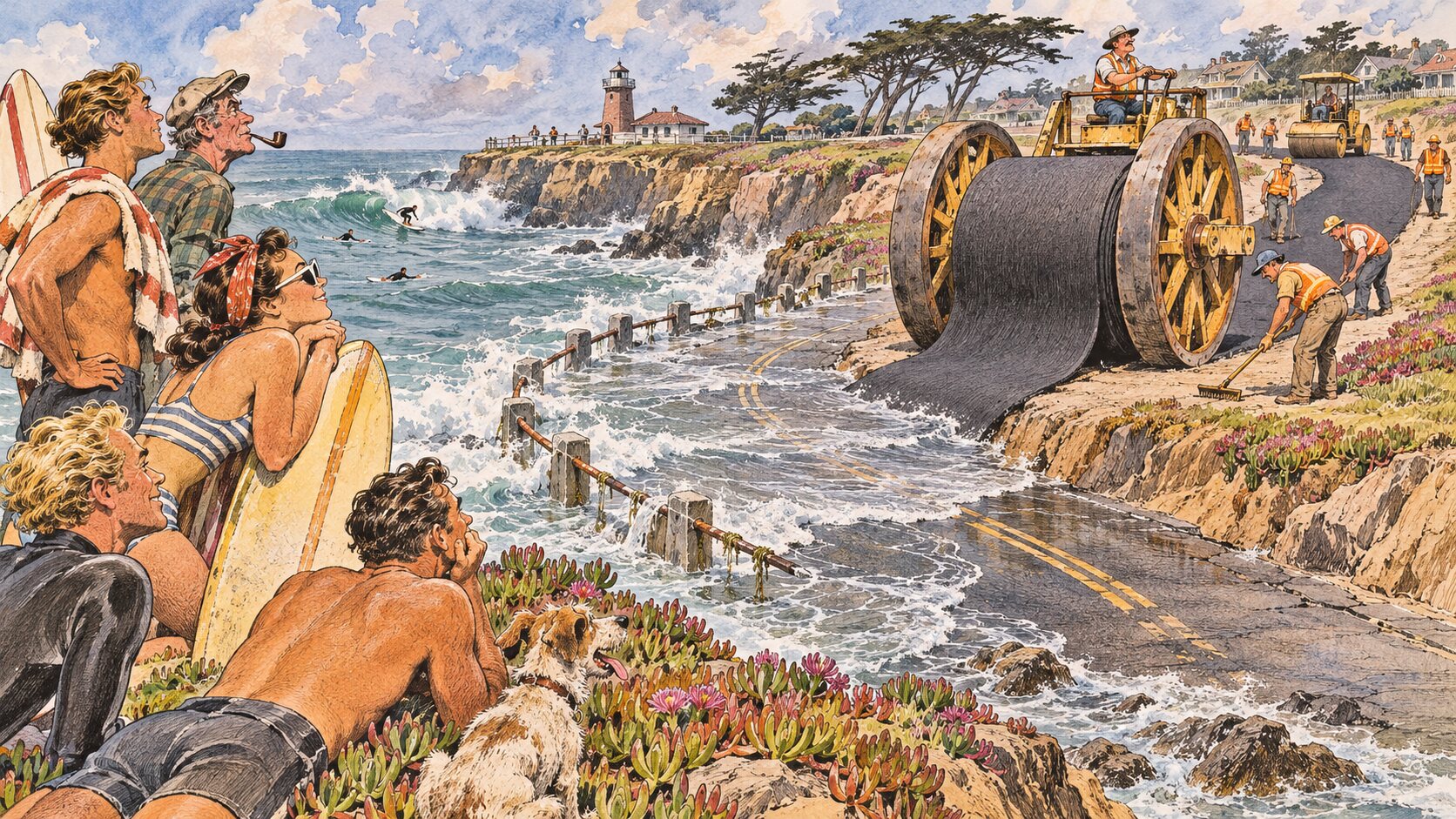
SANTA CRUZ — The City of Santa Cruz will move part of West Cliff Drive inland after the Pacific Ocean declined to respect the original survey, the painted lines or several decades of confident municipal pointing.
The San Francisco Chronicle reported that a 600-foot segment of West Cliff Drive is slated to shift as much as 60 feet inland, with an adjacent pedestrian path moving too. The managed-retreat project near Steamer Lane responds to erosion along the bluff.
West Cliff Drive Relocation Corrects an Ocean-Sized Boundary Dispute

Roads are normally powerful institutions. They have curbs, budgets and people who attend meetings about lane width. The ocean has none of these things, yet continues winning every boundary dispute by arriving without legal counsel.
Invented city surveyor Melvin Stake said crews had explained the property line several times. “We used flags, paint and a laminated map,” he said. “The Pacific responded with geology.”
A clearly comic poll by the fictional Bureau of Coastal Directions found that 88.1 percent of roads prefer not to move after installation. The remaining 11.9 percent were Los Angeles detours and considered relocation their natural state.
The project represents managed retreat, a phrase that makes practical adaptation sound like a military operation conducted by people carrying clipboards. Instead of endlessly armoring every vulnerable edge, the city will shift infrastructure and allow parts of the bluff to erode more naturally.
Surfers Ask Whether the Break Is Also Moving
Steamer Lane surfers reportedly studied the plan and asked the essential question: will the paddle-out remain inconvenient in the traditional way? Fictional planning staff promised to preserve scenic views, access and the local custom of explaining conditions to anyone who has already looked at them.
The Chronicle reported that the relocation is designed to protect pedestrian and bicycle routes and coastal recreation while acknowledging erosion. It also noted broader concerns that hard armoring can scour beaches, alter sediment and threaten surf breaks.
That makes the road move more than a construction story. It is a public admission that the coastline is not a fixed decorative edge around a city. It changes, sometimes gradually and sometimes between two photographs.
Moving Inland Without Leaving the Coast
Residents are entitled to debate cost, access and design. They are not entitled to require the bluff to remain where it was during a favorable mortgage appraisal. Adaptation works best when communities act before a lane stripe becomes marine habitat.
Invented real-estate agent Sandy Escrow immediately listed the new alignment as “ocean-adjacent with a motivated coastline.” She declined to define “adjacent.”
For visitors, the practical message is simple: respect construction zones, unstable cliffs and closures. A dramatic view is not improved by standing beyond a fence. The most authentic Santa Cruz experience remains returning home with all the same limbs.
The Pacific has not agreed to the new survey either. City planners understand this. They are moving the road out of a projected erosion zone, not declaring permanent victory.
By next year, motorists may travel inland while the old edge returns to a more natural bluff. The ocean will take no credit. It has never issued a press release, which may explain its unusually high project-completion rate.
Disclaimer
The relocation dimensions, managed-retreat plan and coastal context come from the linked reporting. The surveyor, poll, planner quotations and real-estate listing are comic inventions. This is entirely a human collaboration between two sentient beings—the world’s oldest tenured professor and a philosophy major turned dairy farmer.