Big Wednesday & Denny Aaberg

Denny Aaberg, a multifaceted talent hailing from Pacific Palisades, California, made his mark as the co-writer of Warner Brothers’ iconic 1978 surfing film, Big Wednesday. Born in Boston, Massachusetts, in 1947, Aaberg relocated with his family to the sunny climes of Pacific Palisades at the tender age of two. Immersed in the vibrant surf culture by 1959, at just 12 years old, he followed in the wake of his older brother Kemp, one of California’s premier surfers at the time.
Aaberg’s passion for surfing was paralleled only by his musical prowess. He lent his guitar skills to the soundtrack of the 1970 surf film Innermost Limits of Pure Fun and contributed a memorable song to Big Wednesday. This film, a nostalgic nod to the surf and camaraderie of Aaberg’s youth, was inspired by his 1974 Surfer magazine short story “No-Pants Mance,” which reminisced about his wild, wave-chasing days in Malibu during the early ’60s.
Beyond the screen, Aaberg emerged as a custodian of Malibu’s rich surfing heritage. He featured in the 1987 documentary The Legends of Malibu and vividly recounted the unique characters, vibrant scene, and sacred rituals of Malibu surfing in “Tres Amigos,” a detailed feature published in Longboard magazine in 1994. Aaberg likened Malibu to an open-air theatre of ancient Greece, where the drama of surfing unfolded from dawn to dusk, encapsulating the essence of the sport and the community it fostered. His work not only celebrates the exhilarating freedom of surfing but also serves as a testament to its enduring spirit and the timeless allure of Malibu’s legendary waves.
What do we know about the “Big Wednesday” movie?

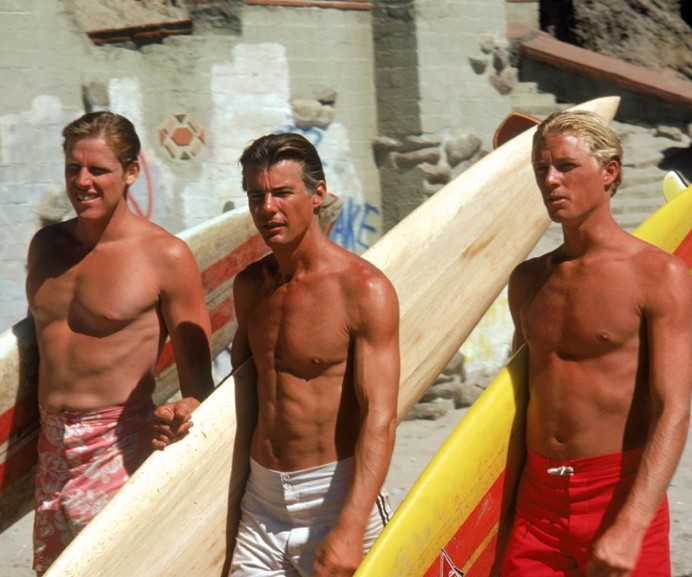
“Big Wednesday” is a seminal surfing film directed by John Milius and released in 1978. The movie, co-written by Milius and Denny Aaberg, is a nostalgic tale that captures the lives, friendships, and surfing adventures of three young surfers over a span of roughly 12 years, from the early 1960s to the Vietnam War era. The main characters, Matt Johnson (played by Jan-Michael Vincent), Jack Barlow (William Katt), and Leroy “The Masochist” Smith (Gary Busey), represent different facets of the surfing culture and the tumultuous changes of the era.
“Big Wednesday” is often celebrated for its authentic portrayal of surf culture and the rites of passage young men face as they come of age. The title refers to a mythic day of extraordinary surfing conditions, a central event in the film that brings the characters together in their mature years, testing their skills, courage, and the bonds of their friendship.
The film is known for its stunning cinematography and realistic surf sequences, capturing the essence of the surfing experience in a way few films have, both before and after its release. Despite a lukewarm reception at the box office and mixed critical reviews initially, “Big Wednesday” has since gained a cult following and is revered in the surfing community for its deep, resonant depiction of surfing’s golden age and the impact of societal changes on the lives of surfers.
John Milius, known for his macho and adventure-laden films, infused “Big Wednesday” with a sense of epic storytelling and personal reflection, drawing on his own experiences and those of co-writer Denny Aaberg. The film also touches on themes of masculinity, friendship, and the inevitable passage of time, making it a poignant narrative that extends beyond the surfing world to resonate with a broader audience. Over the years, “Big Wednesday” has not only become a touchstone for surfers but also a poignant chronicle of youth, camaraderie, and the enduring call of the ocean.
Who wrote the “Big Wednesday” movie?

“Big Wednesday” was co-written by John Milius and Denny Aaberg, bringing together Milius’s flair for storytelling with Aaberg’s authentic surf culture insights.
John Milius: John Milius is an American screenwriter, director, and producer known for his work on films that often feature heroic, macho themes. Born on April 11, 1944, in St. Louis, Missouri, Milius is a prominent figure in Hollywood, with a career spanning several decades. He is recognized for his contributions to cinema both as a writer and a director. Some of his most notable works include “Apocalypse Now” (1979), for which he was nominated for an Academy Award for Best Adapted Screenplay, and “Conan the Barbarian” (1982), which he directed and co-wrote. Milius is known for his conservative views, which have influenced some of his films. His talent for writing dialogues and creating compelling narratives with strong characters has earned him a distinct place in film history.
Denny Aaberg: Denny Aaberg, born in 1947 in Boston, Massachusetts, and raised in Pacific Palisades, California, is best known for his contributions to surf culture through both his music and his writing. Aaberg’s personal experiences as a surfer in the 1960s in Malibu heavily influenced “Big Wednesday.” Before co-writing the screenplay for “Big Wednesday,” Aaberg wrote a short story titled “No-Pants Mance,” published in Surfer magazine in 1974, which captured the essence of the surfing lifestyle and camaraderie. This story, along with his deep knowledge and experience of surfing culture, formed the basis for the film. Aside from his work on “Big Wednesday,” Aaberg has also contributed to the surf music genre, further cementing his status as a multifaceted contributor to the surf community.
Together, Milius and Aaberg created a film that resonates with authenticity and dramatic storytelling, making “Big Wednesday” a beloved classic in the surfing world and beyond. Their collaboration bridged Aaberg’s firsthand surf experiences and Milius’s cinematic vision, resulting in a movie that stands as a testament to the trials, tribulations, and bonds formed through surfing.


By Isabella Velásquez (Playa Del Rey)
Isabella Velásquez is a graduate of the Universidad de Los Andes in Colombia, where she majored in Journalism. Isabella's journey to Playa Del Rey saw her transition from covering political unrest in Latin America to celebrating the unifying power of surfing. Her stand-up surfing style is as bold as her reporting, and she's equally adept at breaking down complex topics in her comedy sets, making her a versatile and respected voice in her field.